
WELCOME BONUS 200%
UP TO €1500 + 200
FREE SPINS
UP TO €1500 + 200
FREE SPINS
Home → Blackjack
Blackjack at Oscarspin: Variants, Rules and Payouts
What Push Means: Stake Returns to You
A push in Blackjack, often encountered in variants like Blackjack 6 Decks, signifies a tie between the player's hand and the dealer's hand. When this occurs, the player's original stake is returned directly to them without any profit or loss. This outcome is crucial for understanding the game's mechanics and managing your bankroll effectively. Understanding this outcome is key to navigating the game's nuances.
While the RTP for Blackjack 6 Decks is listed as 99.54%, a push does not contribute to this theoretical return, as no money is won or lost. The house edge of 0.46% is calculated based on all possible outcomes, including wins, losses, and pushes. The specific rules, such as dealer standing on soft 17, also influence the frequency of pushes.
For a player, a push means their bet remains unchanged, preserving their capital for subsequent rounds. This is different from a loss where the stake is forfeited, or a win where a payout is received. In games where the payout for a Blackjack is 3:2, a push is simply the return of the initial bet, often €10 or €50, without the additional profit.
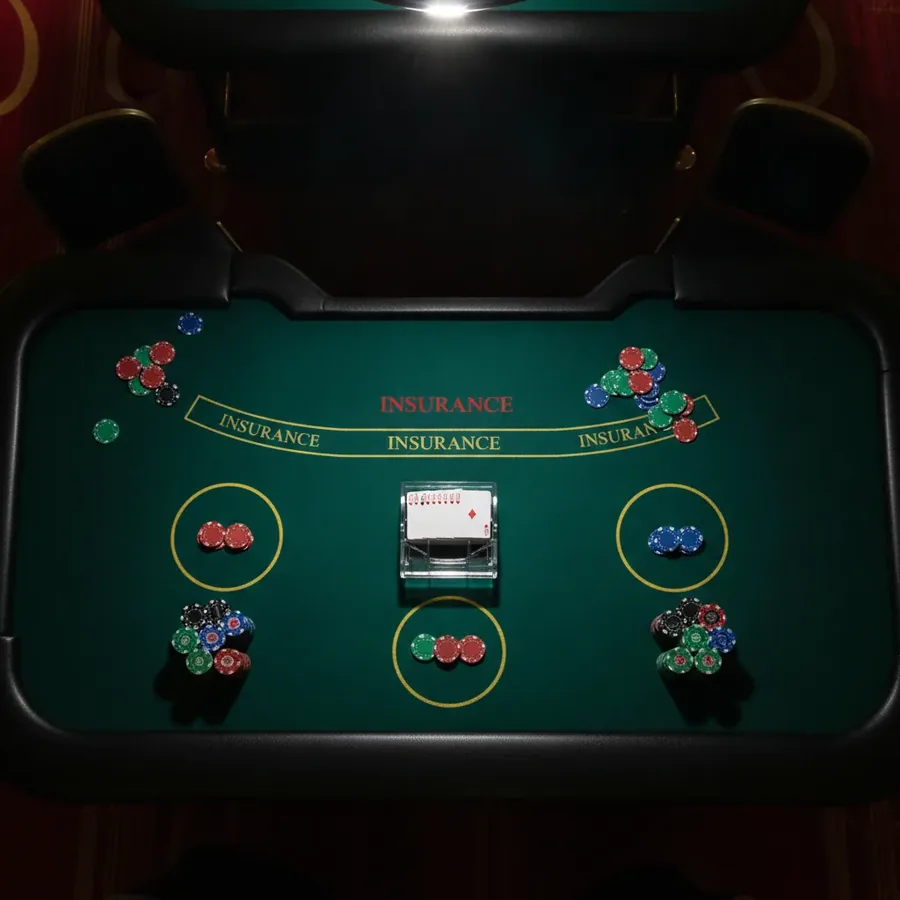
Six Decks to Eight Decks in the Shoe
The number of decks used in a Blackjack shoe directly impacts the house edge, with fewer decks generally favouring the player. For instance, Blackjack 6 Decks has an RTP of 99.54%, corresponding to a house advantage of 0.46%. This is a common configuration in many online casinos, offering a balanced game for players.
Comparing this to a theoretical scenario with one deck, the house edge can be significantly lower, potentially dropping by approximately 0.48 percentage points compared to 8 decks. However, many single-deck variations compensate by offering a less favourable 6:5 payout for Blackjack, increasing the casino's advantage.
The Blackjack Split / Double / H17 variant notes that using 6 decks instead of 8 reduces the house edge by approximately 0.02 percentage points. This marginal difference highlights how subtle rule variations, including the number of decks, can cumulatively affect the overall odds in games offered by providers like Evolution.
Bonus conditions often exclude Blackjack completely
The bonus terms at Oscarspin, specifically a 300% welcome bonus up to €2,000 plus 100 free spins, often come with significant restrictions on which games contribute to wagering requirements. For many online casinos, table games like Blackjack are frequently excluded entirely from contributing to bonus turnover. This means that any Blackjack played will not count towards unlocking the bonus funds.
This suggests that if Blackjack were to contribute, it would be at a heavily reduced rate. Therefore, players aiming to clear the €2,000 bonus would likely need to focus on slot games rather than Blackjack variants.
This exclusion means that while a player might enjoy games like Lightning Blackjack with an RTP of 99.56%, they cannot leverage it to meet the wagering requirements associated with the welcome bonus. The bonus is effectively designed for slot players, making the bonus conditions a critical factor for Blackjack enthusiasts.
Splitting costs double bet: plan budget
The option to split pairs in Blackjack, as available in variants like Blackjack Split / Double / H17, requires the player to double their initial bet for the split hand. For example, if a player has a €10 bet and chooses to split a pair of Aces, they must place an additional €10 bet, making the total stake for that turn €20. This rule necessitates careful budget planning.
The Blackjack 6 Decks variant explicitly states that doubling after a split is allowed, and splitting can be up to 4 hands. If a player opts to split multiple times, the total amount wagered can increase substantially. For instance, splitting two pairs could mean four hands, each with an initial bet doubled, leading to a significant increase in the amount at risk.
To manage funds effectively, especially when considering variants that permit splits and doubles, players should establish a clear budget. A €10 bet multiplied by four potential hands after splits could amount to €40 in play for that single original decision, impacting how many rounds can be played with a set bankroll.
One Deck vs Eight Decks in House Edge
The number of decks used in a Blackjack game significantly influences the house edge, with a single deck offering a considerably lower advantage for the casino. A Blackjack Ein Deck game with classic rules and a 3:2 payout boasts a high RTP of 99.85% and a house edge of just 0.15%. This is often considered a more favourable game for the player.
In contrast, a shoe with eight decks typically results in a higher house edge. The difference between one deck and eight decks can be approximately 0.48 percentage points, making the single-deck game more appealing. This is why casinos often use multiple decks to slightly increase their inherent advantage.
While a single deck game offers a lower house edge of 0.15%, it is crucial to note that many casinos might offset this benefit with less favourable payouts, such as 6:5 for a Blackjack, which significantly increases the house advantage. This comparison highlights the importance of scrutinizing all rules, not just the number of decks.
Blackjack variants at a glance
| Variant | Payout | House edge | Rule | Bet range |
|---|---|---|---|---|
| Blackjack Insurance / Versicherung (6–8 Decks) | 92.53% | 7.47% | Separate Nebenwette bis 50% der Hauptwette, wenn der Dealer ein Ass hat. Basisstrategie schreibt IMMER Ablehnung vor (außer Karten zählen bei True Count ≥ +3). Bei einem Deck Vorteil ≈ 5.88% | Insurance 2:1 |
| Blackjack Liberal Vegas Strip (liberale Regeln, 3:2) | 99.72% | 0.28% | Günstigste Regelkombination: S17 + DAS + Resplit + Late Surrender. Standardabweichung 1,15 | Blackjack 3:2, Gewinn 1:1 |
| Blackjack Split / Double / H17 – Regel-Effekte | n.a. (Regel-Modifikatoren) | H17 +0.22 Prozentpunkte; RSA −0.08 Prozentpunkte; DAS −0.14 Prozentpunkte | Dealer Hits Soft 17 verschlechtert RTP um 0.22 Prozentpunkte; Resplit Aces verbessert um 0.08 Prozentpunkte; Double After Split verbessert um ca. 0.14 Prozentpunkte; 6 Decks statt 8 – ca. 0.02 Prozentpunkte. | Double – Einsatz ×2 mit einer Karte; Split – bis 4 Hände; Ass-Split meist mit einer Karte. |
| Blackjack 6 Decks, S17, DAS, DOA, Auszahlung 3:2, Basisstrategie | 99.54% | 0.46% | Dealer steht auf Soft 17; Verdopplung auf jeder Zweierkarte; Verdopplung nach Split erlaubt; keine Aufgabe. Basisstrategie ist für diesen Wert zwingend | Blackjack 3:2, normaler Gewinn 1:1, Insurance 2:1 |
| Blackjack Ein Deck, klassische Regeln, 3:2 | 99.85% | 0.15% | Weniger Decks = niedrigerer Vorteil; ein Deck gibt ca. −0.48 Prozentpunkte gegenüber 8 Decks. Oft durch 6:5 Auszahlung kompensiert. | Blackjack 3:2, Gewinn 1:1 |
| Blackjack Surrender (Late Surrender) – Regel-Effekt | n.a. (Regel-Modifikator) | −0.08 Prozentpunkte | Spieler gibt Hand nach Dealer-Blackjack-Prüfung auf, verliert die Hälfte des Einsatzes. Verbessert RTP um ca. 0.08 Prozentpunkte. Early Surrender ist wesentlich wertvoller (bis −0.6 Prozentpunkte), aber extrem selten. | Rückzahlung 50% des Einsatzes |
Stand-on-17 Rule and Its Meaning for Players
The rule specifying whether the dealer stands on a soft 17 (S17) or hits it (H17) directly impacts player returns. Blackjack tables offering S17, such as the Blackjack 6 Decks variant with a 3:2 payout, achieve a higher theoretical RTP of 99.54%. This is approximately 0.22 percentage points higher than tables where the dealer hits soft 17.
For players, this means a dealer standing on soft 17 presents a lower house edge. In the Blackjack Liberal Vegas Strip variant, liberal rules including S17 contribute to a very favorable RTP of 99.72%. The difference of 0.22 percentage points means a smaller portion of wagers is retained by the casino over the long term.
Choosing tables with the S17 rule is a fundamental step in optimizing gameplay. This seemingly minor rule adjustment has a quantifiable effect on the house advantage, making it a critical factor for players aiming for better odds. Therefore, players should prioritize finding S17 tables for a more favourable outcome.
Early Surrender is removed from many tables
Early Surrender, a rule allowing players to forfeit half their bet before the dealer checks for Blackjack, is exceptionally rare. While it can improve RTP by up to 0.6 percentage points, its absence is standard on most tables. This significantly benefits the casino by removing a player-favorable option.
Late Surrender, where the player can surrender after the dealer checks for Blackjack, is present on some tables and improves RTP by approximately 0.08 percentage points. This is substantially less impactful than Early Surrender, indicating a shift towards less player-advantageous rules across the board.
The removal of Early Surrender means players cannot mitigate losses as effectively in unfavorable situations. This rule change directly increases the house advantage by roughly 0.52 percentage points compared to tables where it is offered. Players must therefore be more strategic with their betting decisions.
Continuous Shuffling Machine shuffles after each round
A Continuous Shuffling Machine (CSM) is employed at some blackjack tables, which shuffles the deck after every single round of play. This is a common feature on many live dealer blackjack games, including Lightning Blackjack and Infinite Blackjack, both powered by Evolution. The engagement is constant, with no pauses for shuffling.
While CSMs ensure a constant flow of new cards, they fundamentally alter the game's dynamics compared to traditional shoe games. This eliminates the possibility of card counting, as the deck composition never stabilises between rounds. This is a key consideration for players who employ such strategies.
The use of CSMs contributes to a slightly higher house edge because card counting opportunities are nullified. For players not employing card counting, the impact is minimal in terms of immediate gameplay, but it removes a layer of strategic depth available in other blackjack variants.
Four hours of play with 300 EUR bankroll
With a bankroll of 300 EUR, playing for four hours requires careful bet sizing, especially considering the RTP of various blackjack variants. For instance, playing Blackjack Ein Deck with an RTP of 99.85% and a house edge of 0.15% allows for longer play compared to variants with higher house edges.
If a player maintains an average bet of 5 EUR per hand, four hours of play (approximately 240 minutes) could involve around 240 hands, assuming 1 minute per hand. This equates to a total wagered amount of 1,200 EUR over the session, representing 4 times the initial bankroll.
This implies that the 300 EUR bankroll can sustain a significant volume of play, especially on high RTP tables. However, variance means that actual session length can deviate significantly from theoretical calculations. The goal is to manage the bankroll to withstand potential losing streaks.
What doesn't count as Blackjack after Split?
When a player splits a pair, the resulting hands are treated as separate entities. A common rule clarification is that a two-card hand totalling 21 after a split, such as splitting Aces and drawing a 10-value card, is not considered a natural Blackjack. This is a crucial distinction in payout rules.
A natural Blackjack typically refers to an Ace and a 10-value card dealt on the initial two cards. On split hands, achieving 21 with two cards, even if it's an Ace and a 10, usually pays even money (1:1) rather than the Blackjack bonus of 3:2. This rule is standard across most variations.
For example, if a player splits two Aces and receives a 10 on one of them, the resulting 21 is not a Blackjack. This means that a 3:2 payout for a Blackjack is only applicable to the original two-card hand. This rule ensures the house edge is maintained by preventing artificially high payouts from split hands.
No Double Down on three cards
In Blackjack 6 Decks, a player cannot double down on three cards. The RTP for this game is 99.54% with a house edge of 0.46%. This rule modification impacts the standard game by restricting a player's ability to double their bet after receiving their initial two cards.
The Blackjack Split / Double / H17 rules indicate that doubling down is permitted on any two cards, with a RTP impact of -0.14 percentage points for this specific rule. The exclusion of doubling down on three cards therefore means the theoretical RTP is not as optimized as it could be.
For the player, this means that in certain situations where a player might have a strong hand after receiving a third card, they are prevented from increasing their stake. This rule restricts strategic options and consequently affects potential payouts over extended play.
Mobile version needs 1 Mbit bandwidth
The mobile version of Oscarspin games requires a minimum bandwidth of 1 Mbit. This specification is crucial for ensuring a smooth and uninterrupted gaming experience on mobile devices. A stable connection is paramount for live dealer games.
Live dealer games like Lightning Blackjack and Infinite Blackjack, which have RTPs of 99.56% and 99.47% respectively, require consistent data flow. Insufficient bandwidth can lead to disconnections, impacting gameplay and potentially leading to lost stakes.
Players with a connection below 1 Mbit may experience lag or buffering, particularly during fast-paced rounds or when using side bets like those available in Infinite Blackjack. It is advisable to ensure a stable internet connection for optimal mobile play.
Splitting Eights vs Standing on 16
In some blackjack variants, splitting eights is a key strategy when facing a dealer's upcard. The Blackjack Split / Double / H17 rules show that splitting eights can improve the RTP by approximately 0.14 percentage points if doubling after a split is allowed. This contrasts with standing on a hard 16.
Standing on a hard 16 against most dealer upcards is generally a poor decision, as the probability of busting is high. The Blackjack 6 Decks game, with a 0.46% house edge, implies that strategic plays like splitting eights can mitigate losses against the house.
The consequence for the player is that mastering these strategic decisions, such as knowing when to split eights versus when to stand on 16, directly influences the long-term RTP. Improper play can significantly increase the house edge, reducing potential returns.
Ace Split: only one card per hand
When splitting aces in certain blackjack games, the rules often dictate that only one additional card is dealt per split hand. This is a common rule found in variations such as Blackjack Split / Double / H17, where resplitting aces improves the RTP by about 0.08 percentage points.
The Blackjack Liberal Vegas Strip variant, offering a favourable RTP of 99.72%, typically includes the rule allowing players to resplit aces. However, the restriction of receiving only one card per split ace limits the potential for creating strong hands from a split.
For the player, this rule means that after splitting aces, they have a reduced opportunity to build a powerful hand from those new splits. This limitation can affect the overall outcome of hands initiated by an ace split, particularly in games with a higher number of decks.
Blackjack Party runs with two hosts
Blackjack Party, offered by Evolution, provides a unique live dealer experience with two hosts. This variant aims to create a lively atmosphere, differentiating it from standard blackjack tables. The game features bets from 1.00 EUR to 1,000 EUR.
While standard blackjack games focus solely on gameplay, Blackjack Party enhances player engagement through interactive hosting. This contrasts with games like Lightning Blackjack, which prioritises multipliers up to 25x on winning hands, with bets up to 2,500 EUR.
The presence of two hosts in Blackjack Party contributes to a more social and entertaining environment. This setup may appeal to players seeking a more interactive and less intense gaming session compared to high-stakes or multiplier-focused live blackjack variants.
Contact
Live - online chat
Banking









Providers












oscarspin 2025